What a soil-cement eco brick actually is
People hearing “eco brick” for the first time usually picture something fragile and improvised — a material for alternative building. It is the opposite. It has technical standards, laboratory testing and acceptance criteria, and a wall built with it goes up faster and straighter than conventional masonry.
It is worth understanding what it really is.
The material
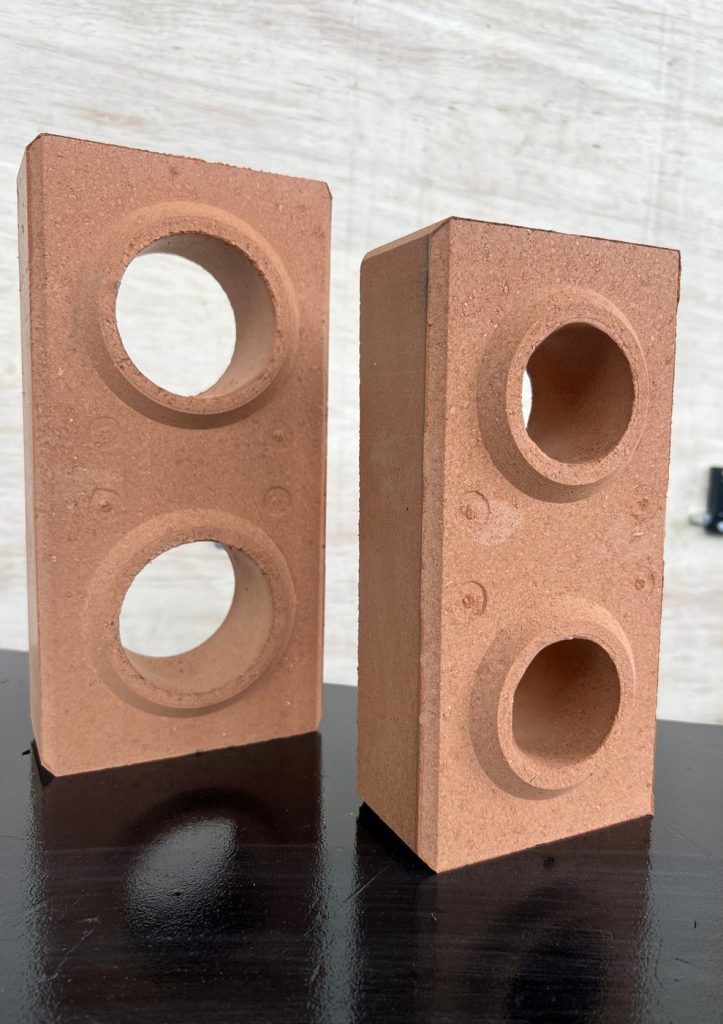
The eco brick is a modular soil-cement block: a mix of soil, cement and water, compacted under high pressure in a hydraulic press and cured with no firing at all.
In market practice, cement makes up around 8% to 10% of the mix. Everything else is soil — preferably sandy, with a controlled clay fraction. That is where the first cost difference comes from: the main raw material can be on the building site itself.
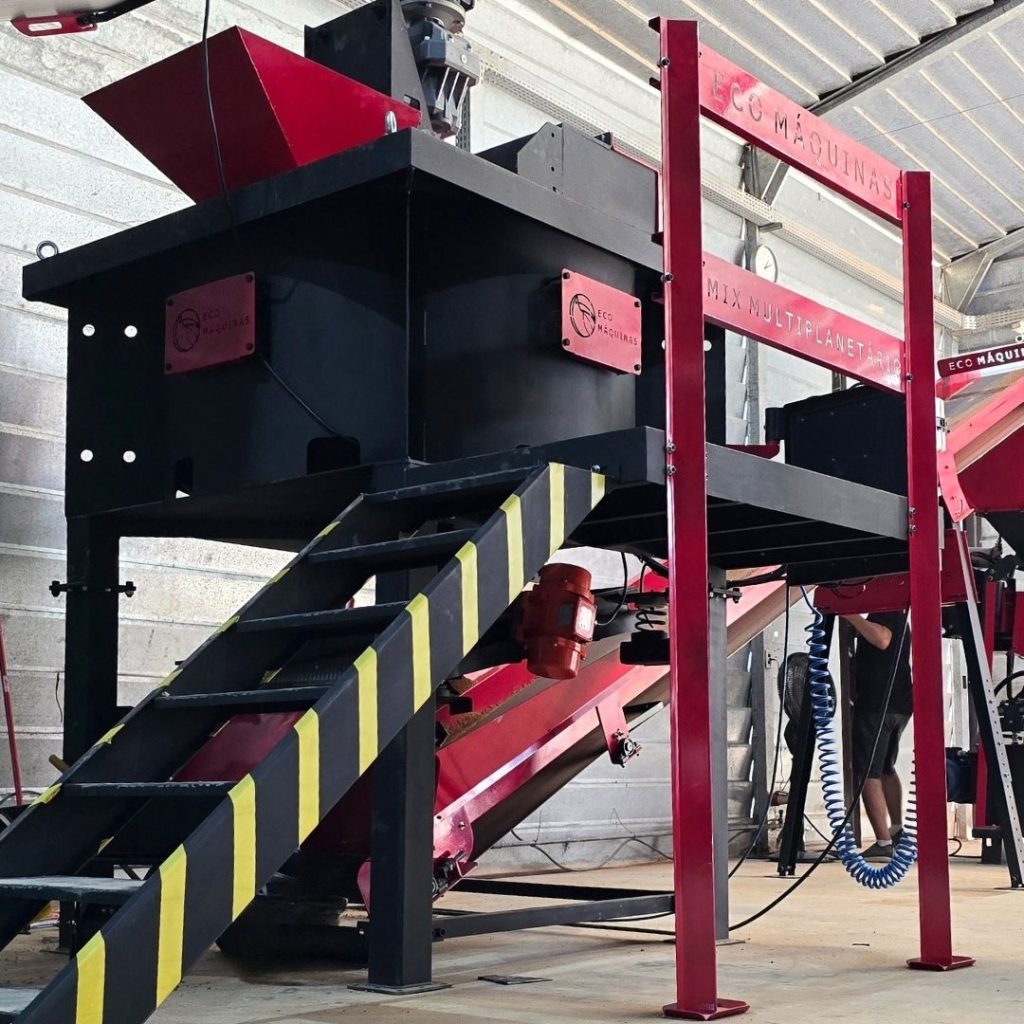
The second difference is the absence of a kiln. Ordinary ceramic brick has to be fired, which means wood or gas, smoke, and an investment that only makes sense at scale. The eco brick gains strength from pressure and curing, not from fire.
What turned this into a building system
Soil-cement is not new. What changed the game were two design details.
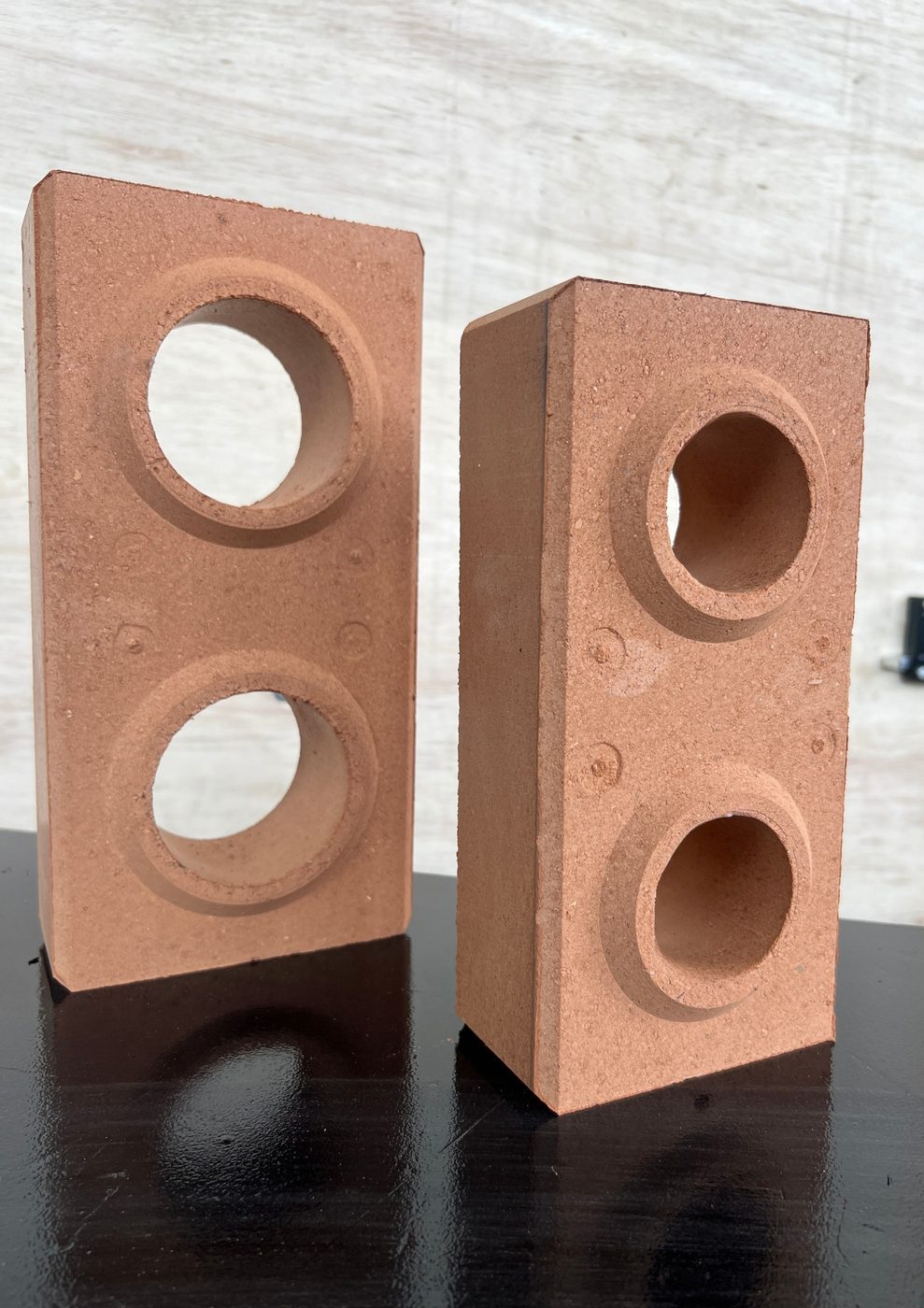
The vertical holes. Two through-holes run from top to bottom of the piece. As courses stack, they line up and form continuous ducts inside the wall. Conduits and small-diameter pipes run down through them — no chasing, no breaking, no rubble. And at the points set by the structural design, those same holes take reinforcement and grout, forming a column built into the wall itself.
The tongue-and-groove interlock. The piece has a ridge on one side and a groove on the other. It locks onto the one below and aligns itself. That removes the mortar joint between courses: only the first course is laid with mortar, to level the base. From the second course on, laying is done with a thin bead of polymer mortar adhesive.
Those two details are why the material is treated as a building system rather than as just another alternative brick.
Is there a standard?
There is, and the numbers are worth knowing:
- NBR 8491 and 8492 — cover the soil-cement brick. NBR 8491 requires a minimum average strength of 2.0 MPa at 7 days.
- NBR 10833 — covers manufacturing with a hydraulic press.
- NBR 10834 and 10836 — cover the hollow soil-cement block.
With selected soil, the right mix, a high-pressure press and proper curing, it is common to go well beyond that 2.0 MPa floor. Whoever controls the process controls the strength — and that sentence is more literal than it sounds.
What changes on site
The wall comes out of the press dimensionally precise. That has three direct consequences:
- Less mortar. The interlock drastically reduces laying material — the saving reaches 70%.
- Less render. The wall already goes up aligned. You can leave it exposed with varnish, paint it directly, or render it in a much thinner layer. When render is used, it takes up to 8 times less material than ordinary masonry.
- Practically no rubble. There is no breaking for services, and whatever is left over can go back into production.
Wall raising is also faster — two to three times, with a trained bricklayer. And trained here does not mean specialised: the method is simpler than conventional masonry. What changes is the first few days, until the crew picks up the rhythm of the interlock.
And the curing
This is the stage that sets final strength, and the most neglected one.
Curing starts right after pressing and continues for 3 to 7 days, depending on the cement, with the piece always moist. In every method the bricks are covered with plastic film once stacked. Brazilian standard ABNT considers curing complete at 28 days, though in practice most builders use the bricks right after moist curing.
None of this needs a kiln, an oven or energy. It needs method.
Who is it for?
For whoever is building, the gain is cost and speed. For whoever is thinking about producing, the gain is of a different nature: with raw material available and no firing cost, the eco brick is one of the few construction materials a small producer can manufacture to a certified standard.
That is why a good share of those who start producing for their own build end up selling to their region.
Next: see how a soil-cement brick is made, from soil to pallet or browse the machine range.